
Certum services
available on 6 continents
10 Years
Of experience
Authorized Certum partner
Technical infrastructure located in the EU
99.9%
Satisfied customers
Electronic Signature
Convenient and secure document signing
Electronic Signature
Convenient and secure document signing
Electronic Signature
Convenient and secure document signing
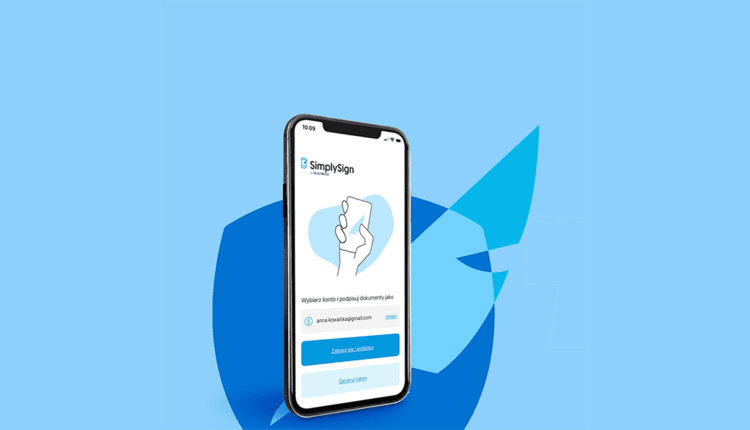
SimplySign
A simple solution that allows you to sign documents electronically without the need for cards or readers. You can use it on your smartphone, tablet, laptop, or desktop computer..
Remote identification of international clients.
ABOUT THE SIGNATURe
Where can you use an electronic signature?
Remote signing of civil law contracts, identity verification in dealings with public authorities, granting powers of attorney, or signing commercial agreements are just some of the use cases of electronic signatures.
Electronic signatures are becoming increasingly common, which is why their range of applications continues to grow. Today, they are used not only by large enterprises but also by individuals. It’s a secure tool that allows you to sign documents without leaving your home or office.
Why choose it
24/7 access
Compliance
Convenience
Simplicity
Who is an electronic signature for?
- B2B and B2C contracts
- HR documents
- Tender documents
- Public procurement
Companies and Public Institutions
It significantly speeds up document workflows and the signing process within your company or institution.
- B2B and B2C contracts
- HR documents
- Tender documents
- Public procurement
Individuals
Reliable for dealing with public authorities and everyday formalities. A convenient solution for daily use.
Frequently Asked Questions
- Confirm your identity in contacts with government offices
- Sign and submit tax declarations in the Płatnik system
- Submit e-declarations to ZUS
- Participate in electronic auctions on tender platforms
- Submit offers in tenders
- Sign civil law agreements
- Submit various types of letters, applications, and forms to institutions such as courts, CEIDG, GIODO, and KRS
Obtaining an electronic signature is not complicated. All you need to do is schedule a meeting with our advisor – online or in person in Warsaw. During the meeting, a professional consultant will guide you through the entire process related to setting up, implementing, and using the electronic signature. They will verify your identity and answer any questions related to the e-signature. After the meeting, you will be able to sign documents electronically without any restrictions.
In summary – all necessary formalities can be completed during a single meeting, which takes approximately 30 minutes per person.
A qualified electronic signature is a type of signature that has the same legal validity as a handwritten signature. The key element is the qualified certificate, which confirms the identity of the person signing the document. It is this certificate that gives it the same legal value as a handwritten signature.
A qualified electronic signature provides significant time savings because you can sign the entire document together with all of its attachments at once. At the same time, it protects the signed document and its attachments against unwanted modifications.
It’s simple! All certificates and electronic signatures are automatically recognized by Adobe applications. Just open the document in the program, and if it has been electronically signed, a notification will appear at the top of the application.
The constantly growing popularity of electronic signatures results in more questions about their security. It is worth mentioning that electronic signatures are defined by the Electronic Signature Act of 2016 and by the eIDAS Regulation of the European Parliament and the Council of the European Union.
The regulations clearly define the characteristics of a secure electronic signature:
- it must be linked to data in such a way that any later modification can be detected;
- it must be assigned exclusively to a single person using the signature;
- it must be created using secure devices and remain under the sole control of the person responsible for signing.
Appropriate legal regulations effectively ensure the security of such solutions, and it can be confidently stated that an electronic signature is much more difficult to forge compared to a traditional handwritten signature.
In Poland, the use of electronic signatures is regulated by the Act of 18 September 2001 on Electronic Signatures and the Act of 5 September 2016 on Trust Services and Electronic Identification. Within the European Union, the standardization of electronic signatures is governed by Regulation (EU) No 910/2014 of the European Parliament and of the Council of 23 July 2014 on electronic identification and trust services for electronic transactions in the internal market, also known as the eIDAS Regulation.
The Act of 18 September 2001 on Electronic Signatures regulates issues related to recognizing electronic signatures as a form of identity confirmation for the person signing. According to the act, an electronic signature is equivalent to a handwritten signature, provided that it meets specific legal requirements.
The eIDAS Regulation (Regulation on Electronic Identification and Trust Services for Electronic Transactions in the Internal Market) is an EU legal act that regulates electronic identification and trust services for electronic transactions. This regulation replaced Directive 1999/93/EC and establishes standards for the implementation and use of electronic signatures and other trust services across European Union member states.